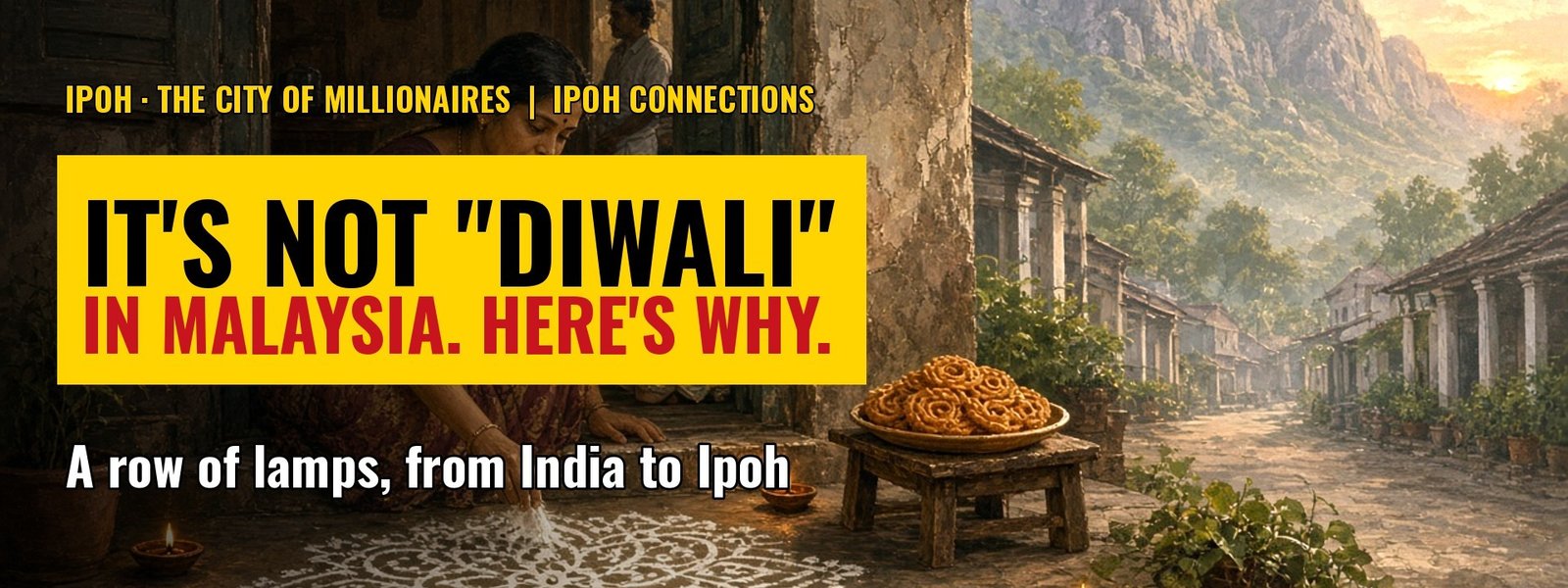
Diwali or Deepavali? How a Row of Lamps Travelled from India to Ipoh, and Why We Say It Differently Here
Same festival, two names. One came with the Hindi-speaking north. The other came with the Tamil workers who cleared Malaya's estates and laid its railways. So which one is right? Both. Here is why.
You've squeezed through Little India in Ipoh in the week before Deepavali. Stalls spill onto the five-foot ways off Jalan Lahat and Jalan Sultan Yussuf, jasmine garlands hang next to stacks of brassware, and someone is frying muruku close enough that you can smell it from the car.
Or you've been handed a plate at a friend's open house and wondered why your cousin in Delhi calls the same day "Diwali".
What is Deepavali? Deepavali is the Hindu festival of lights, celebrated across Malaysia, India and the Indian diaspora in October or November. The name comes from Sanskrit dīpāvali, "a row of lamps". In 2026, Malaysia's Hari Deepavali public holiday falls on Sunday, 8 November, in every state except Sarawak, with Monday, 9 November, a replacement holiday in most states, Perak included, according to the federal government's 2026 holiday list.
Hold that question about the two names. We will come back to it.
ONE FESTIVAL, MANY STORIES
Deepavali does not have one origin story. It has several, and which one you grew up with depends on where your family came from.
In North India, the best-known story comes from the Ramayana. Prince Rama returns to Ayodhya after fourteen years of exile and his victory over Ravana, and the people light rows of lamps to welcome him home.
In South India, and so for most Malaysian Hindus, the centre of the story is Krishna's defeat of the demon king Narakasura. Tradition says Narakasura asked that his death be marked with lights and celebration, and the day became Naraka Chaturdashi: light over darkness, good over evil.
Across India, the festival is also tied to Lakshmi, the goddess of wealth and good fortune. Homes are cleaned, doors left open and lamps lit so she will feel welcome. Some communities, including many Bengali Hindus, worship the goddess Kali on the same night instead.
Other faiths share the date too. Jains mark it as the day Mahavira, the last Tirthankara, attained final liberation (nirvana). Sikhs celebrate Bandi Chhor Divas, remembering Guru Hargobind's release from imprisonment in Gwalior Fort; the Golden Temple in Amritsar is lit up for it. Some Buddhists, especially Newar Buddhists in Nepal, observe the festival as well, and many accounts link it to the Mauryan emperor Ashoka's conversion. That link comes from tradition rather than firm historical record.
HOW THE LAMPS REACHED MALAYA
Indians traded with the Malay world for centuries, but the Deepavali most Malaysians know arrived with the great migration of the colonial era.
After the 1874 Pangkor Treaty, British planters opened estates in Perak, Selangor and the other Malay states, and the colonial government needed labour. Most of it came from South India, mainly Tamils, shipped through Penang and Singapore, especially after the Indian Immigration Ordinance of 1884. A history published by Economic History Malaysia notes that Indians made up the majority of estate workers by the early 20th century. Tamil workers also built Malaya's roads, railways and ports, and smaller numbers worked as clerks, technicians and teachers. Tin mining was mostly a Chinese industry, but the railway lines that carried Kinta's tin to the coast were built and run with a great deal of Indian labour.
Every estate line and railway quarter brought its festivals along. On Deepavali morning the lamps went out along the steps of the line houses, a few sweets came out, and the shrine at the end of the row got a fresh garland.
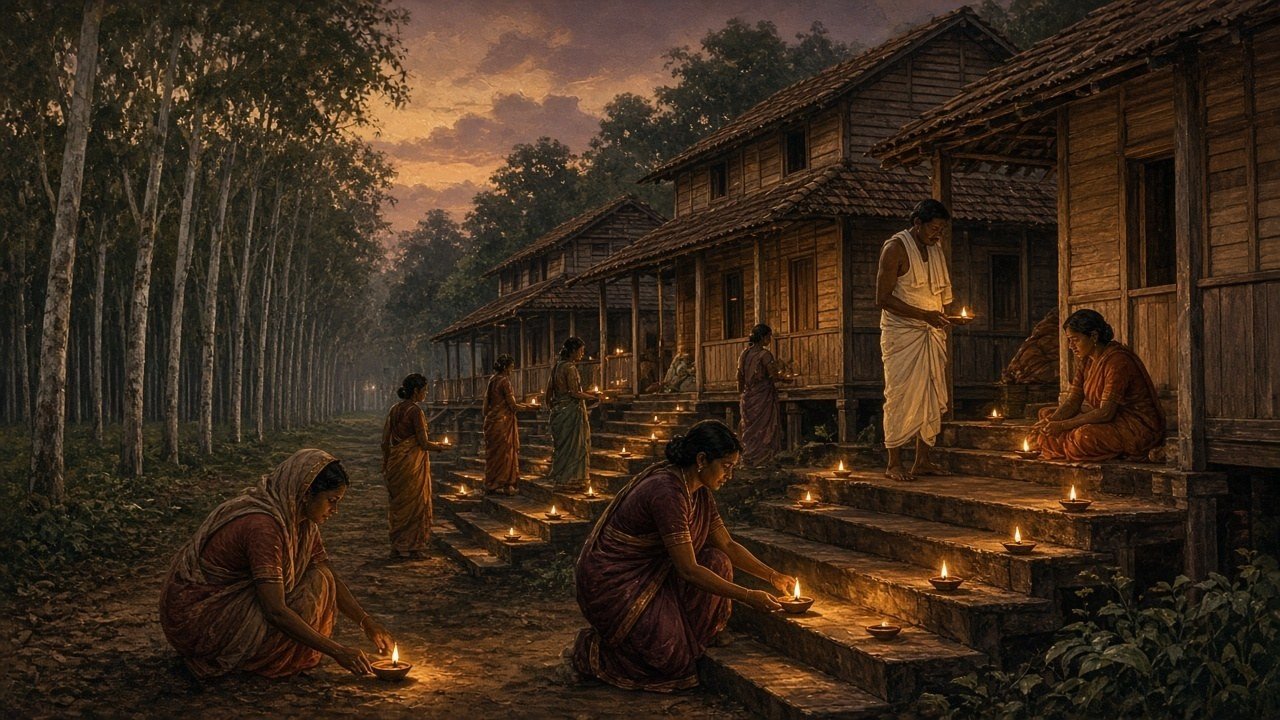
IPOH'S OWN LAMPS
In Ipoh, the festival found permanent homes.
Little India grew up on the streets around Jalan Lahat, Jalan Sultan Yussuf and Jalan Bendahara, and every Deepavali those streets fill with shoppers. A few kilometres out, at the foot of Gunung Cheroh, stands the Kallumalai Arulmigu Sri Subramaniar Temple. Temple histories say it began in 1889 as a cave shrine inside the limestone hill. After a fatal rockfall during Thaipusam in 1926, the authorities ordered the cave closed, and a new temple was built nearby, completed around 1930 to 1932. Its 21-metre rajagopuram, finished in the 2010s and carrying more than 500 sculpted figures, was reportedly paid for by traders from Jalan Bendahara. Kallumalai is best known for Thaipusam, but its bells and its crowds are part of Ipoh's Deepavali too.
FROM PETITION TO PUBLIC HOLIDAY
Deepavali was not always a day off. According to a 2020 Malay-language newspaper feature, Indian representatives petitioned the British in 1912 and 1914, and Deepavali became a public holiday in the Federated Malay States and the Straits Settlements during the 1920s. Singapore's records date its holiday to 1929. The same feature says a Dravidian movement pushed in 1947 for Ponggal to replace it, though the holiday survived.
Today Hari Deepavali is a federal public holiday everywhere except Sarawak. It is still only one statutory day, compared with two for Hari Raya Aidilfitri and Chinese New Year, which some groups are campaigning to change.
Then there is the open house. Malaysians of every background walk into Indian homes for muruku, rice, mutton curry and too many sweets, and nobody checks whose festival it is.
DIWALI OR DEEPAVALI: WHY THE TWO NAMES?
Now back to that question.
Deepavali is the original Sanskrit: dīpa (lamp) and āvali (row). Diwali is the shortened form used in Hindi and other North Indian languages. Both mean a row of lamps.
Most Malaysian Indians trace their roots to Tamil Nadu, and Tamil keeps the longer form. In Tamil script it is தீபாவளி, which is why you will also see it spelt Theepavali or Thipavali. Malaysia's official calendar uses "Hari Deepavali" for the same reason.
The rituals differ too. In the South Indian tradition the main day is Naraka Chaturdashi, the day before the new moon. Families wake before dawn for an oil bath: sesame oil on the head, then a bath, then new clothes, prayers and the first sweets of the day. The bath is said to be as cleansing as a dip in the Ganges. In the North the main event is the Lakshmi puja in the evening of Amavasya, the new-moon night.
Because the Tamil reckoning centres on Naraka Chaturdashi, Malaysia's Deepavali often falls a day before North India's Diwali. In 2026, Indian panchang calendars put both observances on Sunday, 8 November, so Ipoh and Delhi celebrate on the same day.
KOLAM, MURUKU AND THE DAWN BATH
The details are what children remember.
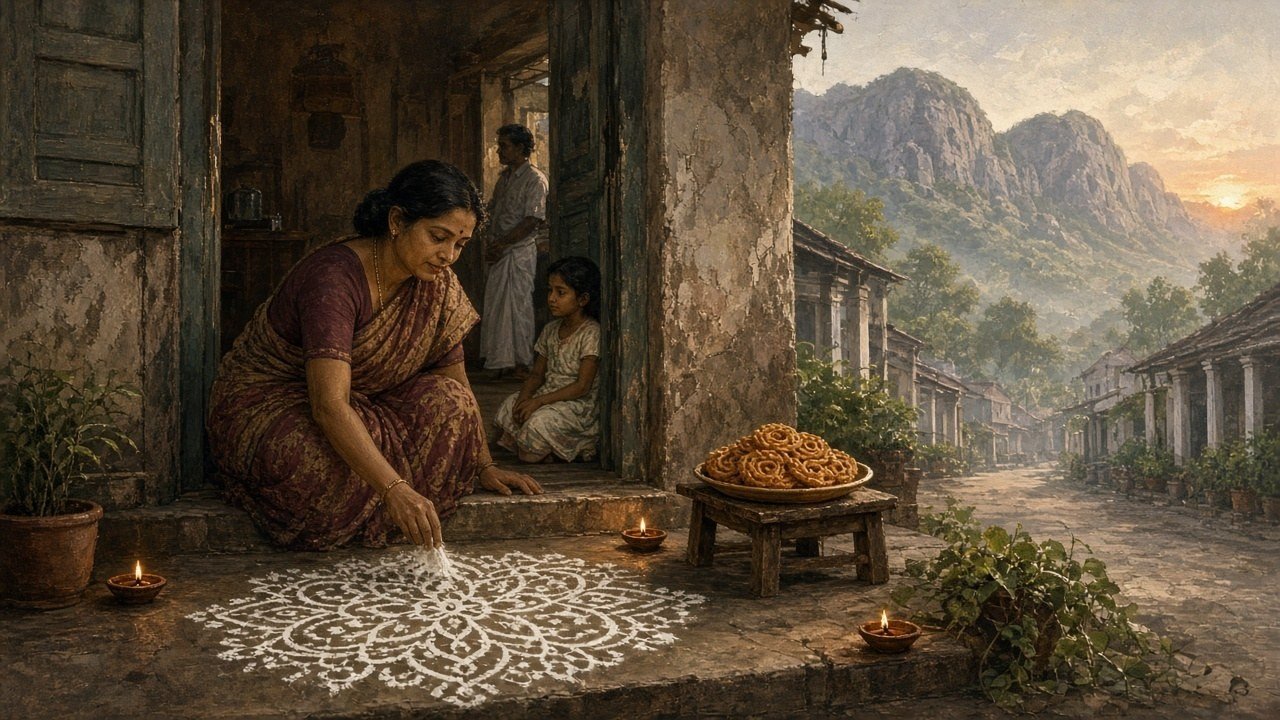
The kolam is a pattern drawn at the doorstep in rice flour, white or coloured. It is said to welcome guests and, because it is made of rice, to feed ants and birds too. Malaysian kolam often grow huge, and you will find them in mall atriums every November.
The muruku is a spiral of rice and urad dal flour, fried until it crunches. In many homes, aunties start making it weeks ahead.
The oil bath comes before sunrise, often with an elder dabbing oil on each child's head. Then come the new clothes, the temple, and the first visitors at the door.
HERE IS WHAT WE CAN LEARN FROM IT
Names travel with people. The word your family uses for a festival records where they came from, which boat they took and which language their grandmother prayed in. Diwali and Deepavali are not rivals. They are the same row of lamps, carried by different families.
The festival also travelled because it was shared. Estate workers far from home lit lamps anyway. Ipoh's temples outlasted rockfalls and rebuilding. Open houses turned a Hindu festival into an occasion for the whole country.
And a lamp doesn't have to be big. You only need to light one, put it beside the next, and keep going.
HAPPY DIWALI, HAPPY DEEPAVALI
To all our friends celebrating in Malaysia this Sunday, 8 November: Happy Diwali and Happy Deepavali from all of us at Rochford's International School. May your lamps burn bright, your kolam stay unsmudged and your muruku tin never run empty.
A row of lamps, carried from one shore to another.
Ipoh shaped their story. Whose story will Ipoh shape next?
Sources: Jabatan Perdana Menteri, Hari Kelepasan Am 2026 (kabinet.gov.my); timeanddate.com and publicholidays.com.my, Deepavali 2026 Malaysia; Drik Panchang, Diwali 2026 Lakshmi Puja timings; Economic History Malaysia, "South Indian labour in Malayan rubber estates, 1884–1941"; Journal of Indian Studies (Universiti Malaya) on Indian migration after Pangkor; a Malay-language newspaper feature, "Deepavali bukan sekadar muruku" (2020); Remember Singapore, public holidays history; kaumaram.com and a local community newspaper (2016) on Kallumalai temple; a Malaysian news report (3 Nov 2026) on the Deepavali holiday.
This story carries our Ipoh Connections label, for people whose stories run through Ipoh and Perak. It is part of Ipoh Stories, our City of Millionaires heritage series. At Rochford's International School in Ipoh, we believe history, character and critical thinking are best learned through real stories, including the stories of our own city.
Stories in this series are shared for informational and educational purposes. Where accounts differ, we say so. We respect all races, religions and cultures, and we do not represent or endorse any political party or movement.