A.B. HUBBACK, THE ARCHITECT OF IPOH RAILWAY STATION: THE MAN WHO DREW IPOH'S WHITE SKYLINE, THEN WENT TO WAR AND NEVER CAME BACK TO WORK IN MALAYA
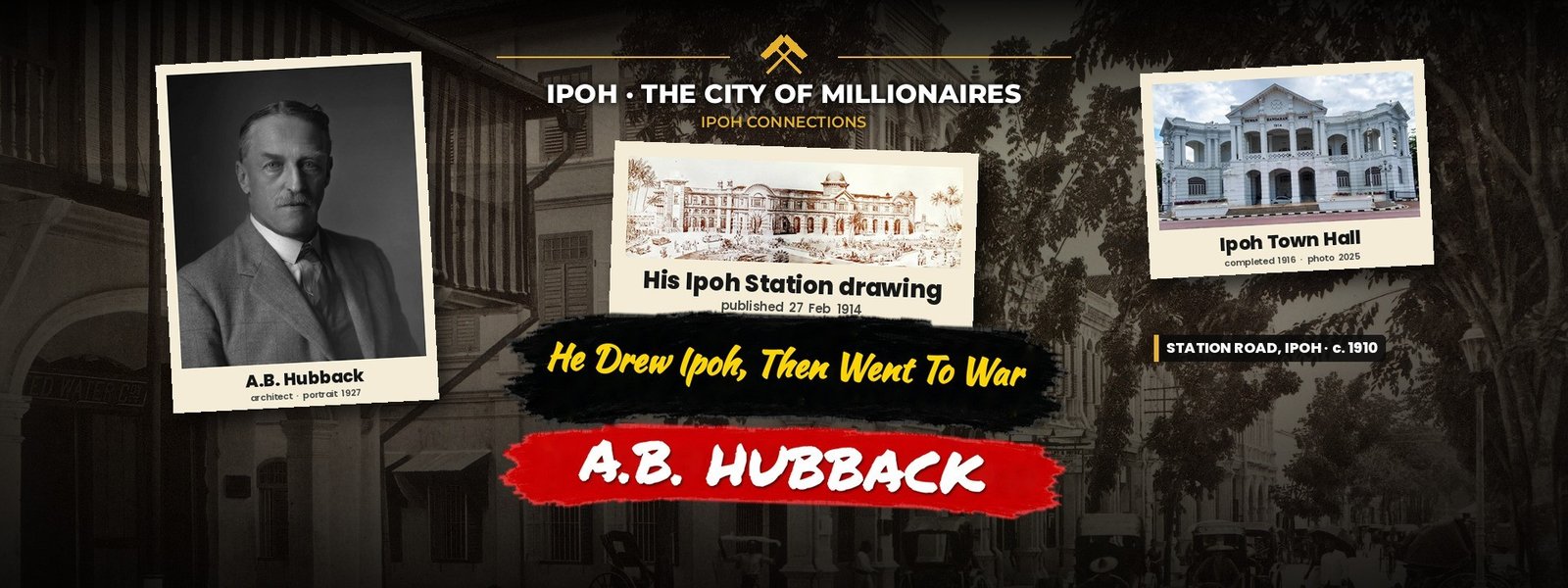
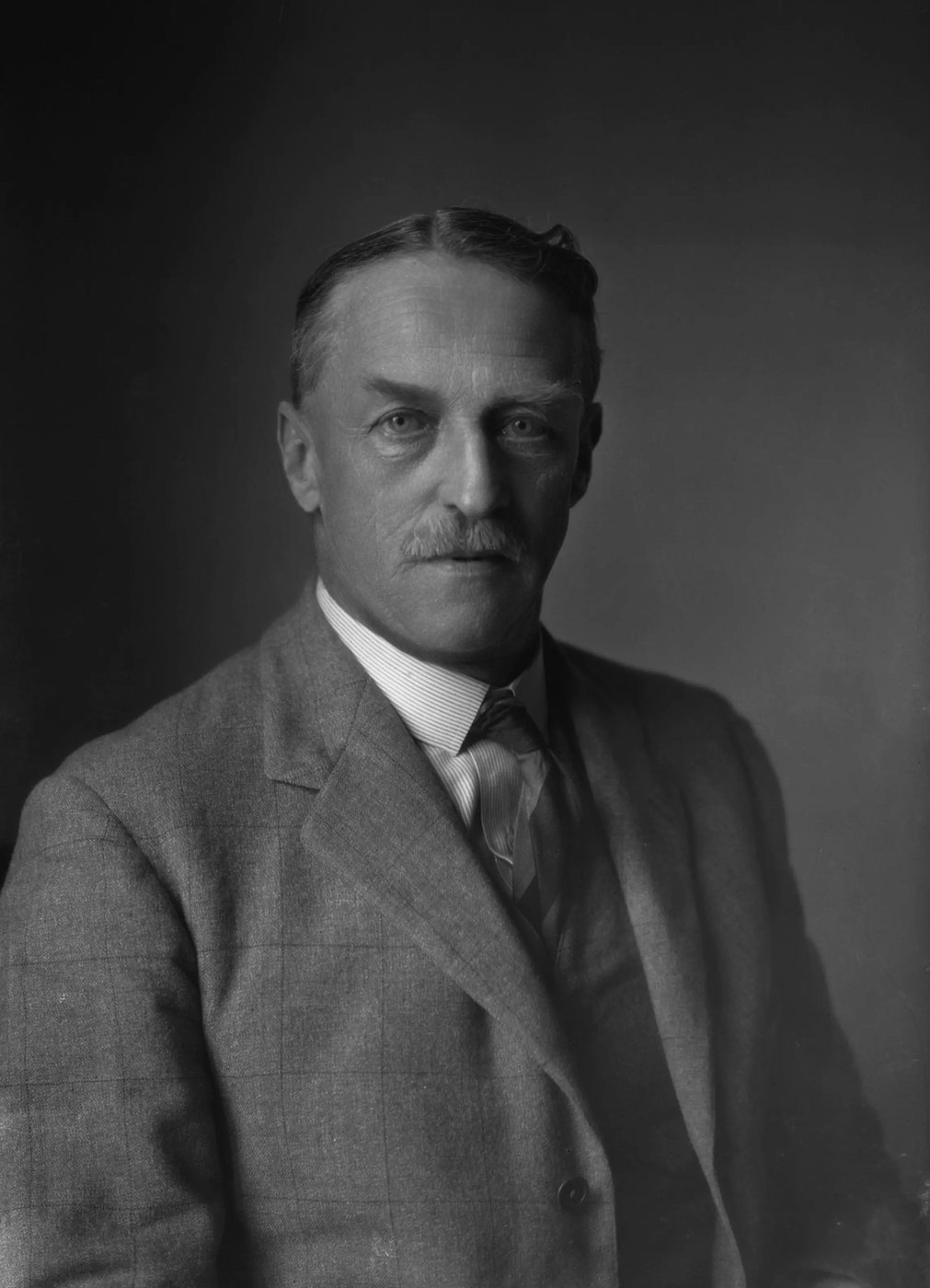
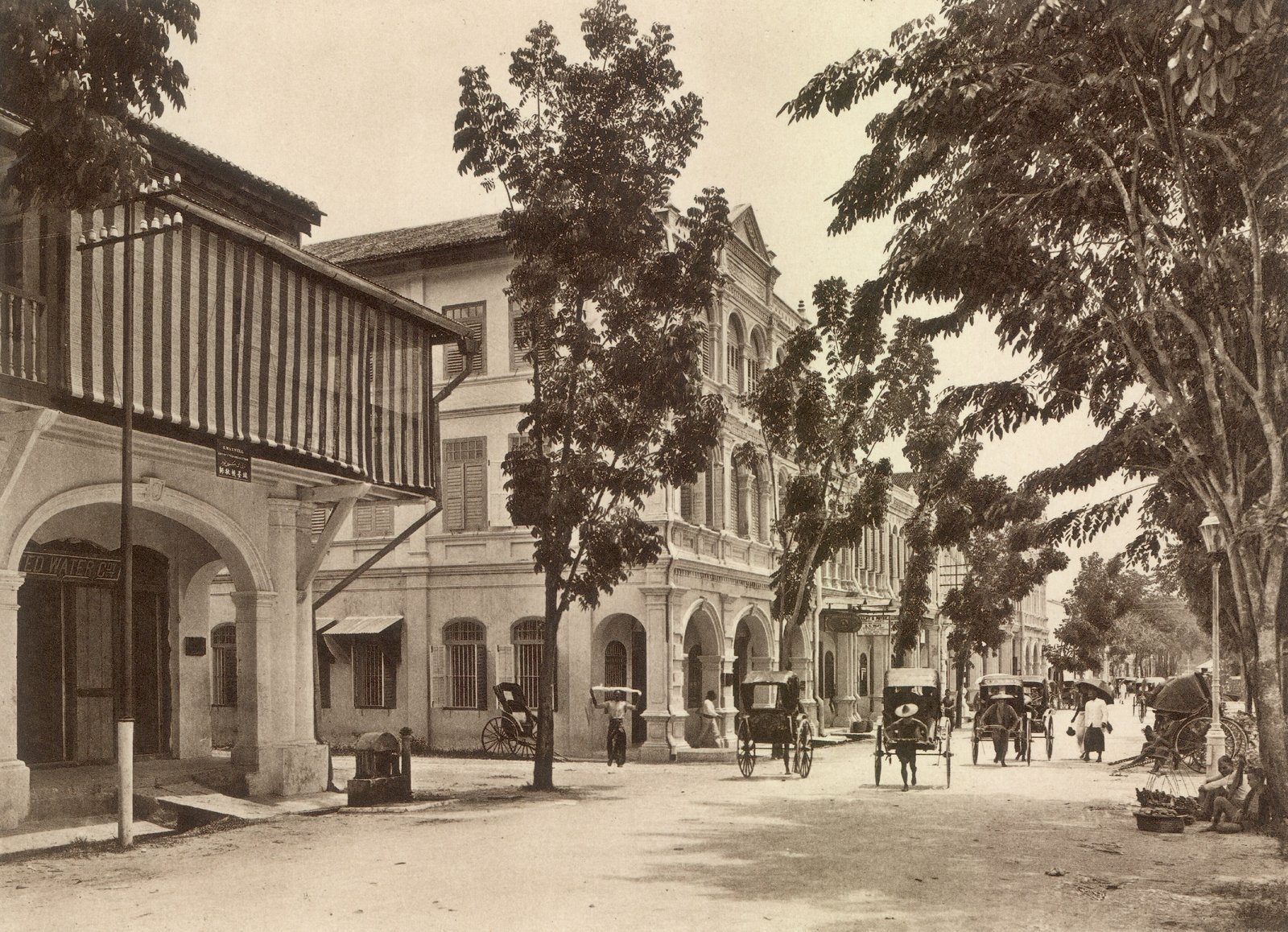
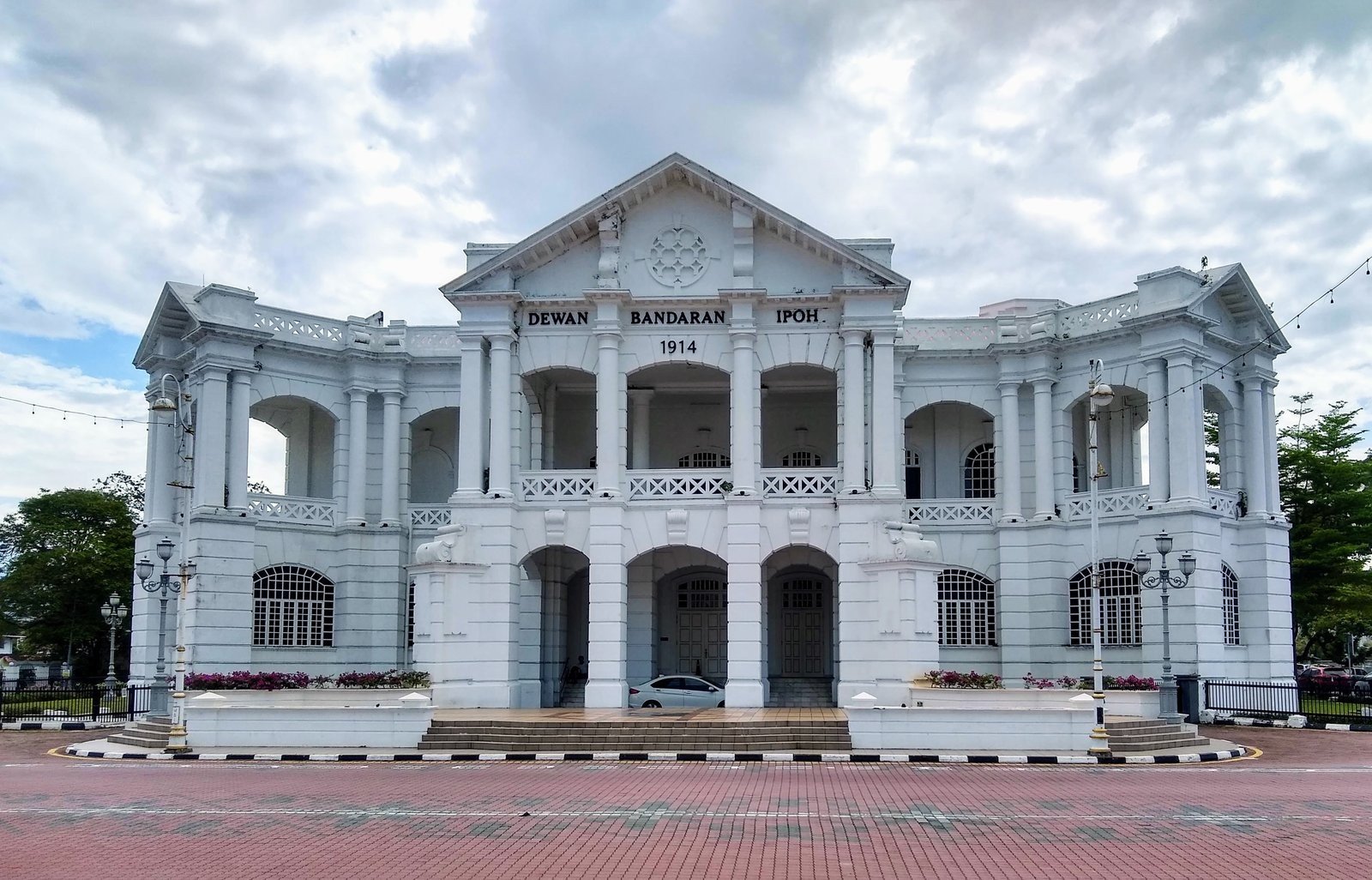
Cover: Arthur Benison Hubback (photo: Lafayette Ltd, 1927, via Wikimedia Commons); his drawing of the new station and hotel at Ipoh, published 27 February 1914 (public domain, via Wikimedia Commons); Ipoh Town Hall, 2025 (photo: C411978, CC BY-SA 4.0, via Wikimedia Commons). Background: Station Road, Ipoh, c. 1910 (photo: C.J. Kleingrothe, public domain, Leiden University Library, KITLV collection 79987, via Wikimedia Commons), darkened.
He designed the buildings Ipoh still poses in front of. When they were finished, he was on the other side of the world, in uniform.
This is the story of the man, not the station. And of the stone in front of it.
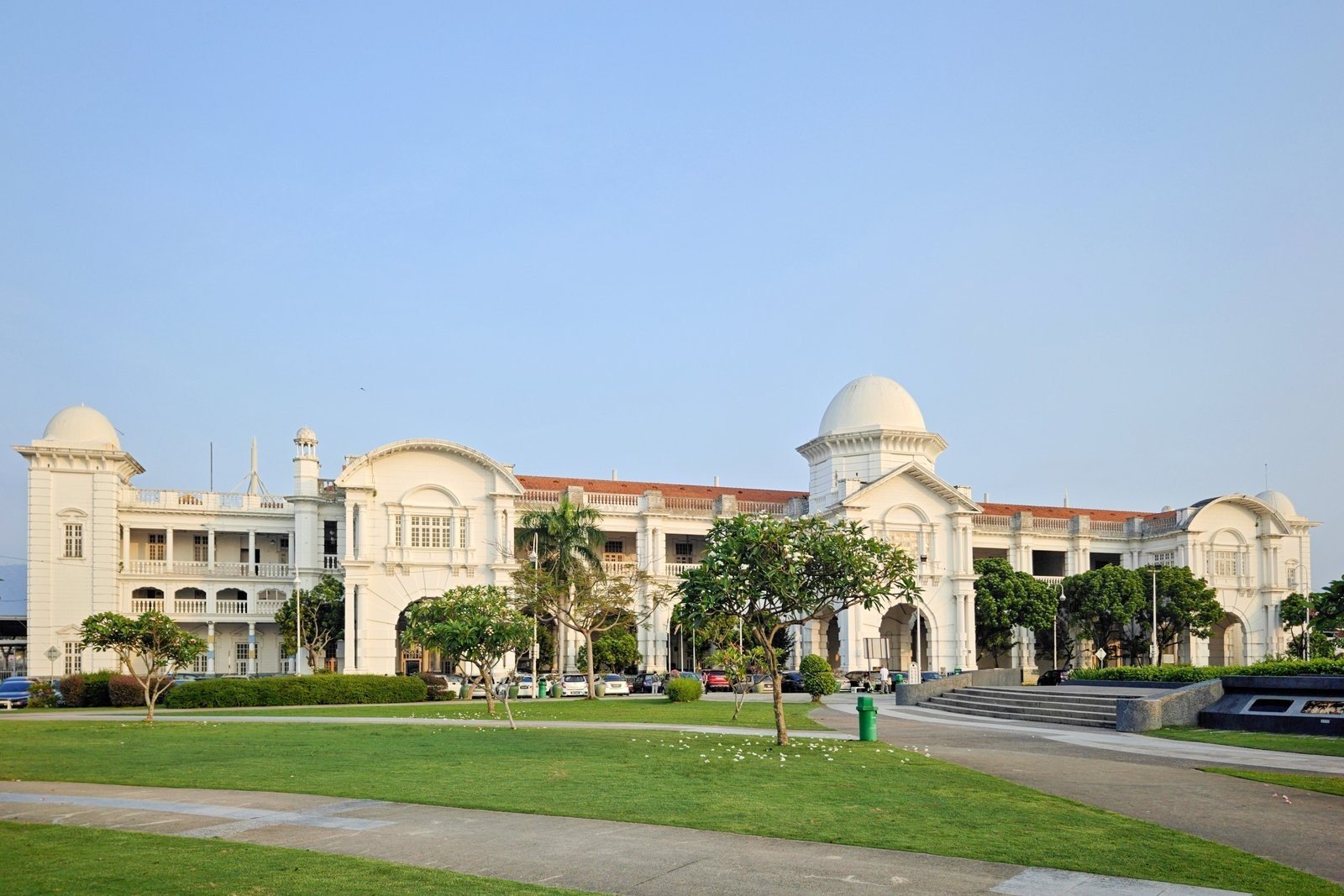
You have stood on the square in front of Ipoh Railway Station, the white domes and arches behind you, phone held up for the same photo everyone takes. Across the road, the Ipoh Town Hall glows white in the afternoon sun.
You may even have walked past the old stone cenotaph in the middle of that square without reading a word on it.
The man who drew the building behind you would have understood that cenotaph better than anyone.
Who was A.B. Hubback? Arthur Benison Hubback (1871-1948), born in Liverpool, England, was the Government Architect of the Federated Malay States who designed Ipoh Railway Station (completed 1917), Ipoh Town Hall (completed 1916) and the original Anderson School building in Ipoh, Perak, Malaysia, as well as Kuala Lumpur Railway Station and Masjid Jamek in Kuala Lumpur, and the Ubudiah Mosque in Kuala Kangsar.
In short: the "Taj Mahal of Ipoh" was drawn by a Liverpool architect who later became a general.
Here is the strange part. Work on the Town Hall and the station got under way around 1913–14. Neither was finished by the man who designed them. A 1930s profile of the architect who did finish them put it bluntly: Hubback "went on leave in 1914 and never came back".
So where did he go? And why did the man who gave Ipoh its grandest buildings never come back to Malaya to work again?
Hold on to that question. We will come back to it.
A BOY FROM LIVERPOOL, AND A FATHER LOST TOO SOON
Arthur Benison Hubback was born on 13 April 1871 at 74 Rodney Street, Liverpool. His father, Joseph Hubback, was a merchant who had served as Mayor of Liverpool in 1870.
Then, in the early 1880s, his father died, leaving his widow to bring up five young children.
Arthur still made it to Fettes College in Edinburgh on a scholarship, then trained under the city architect of Liverpool. In July 1895, at 24, he arrived in Selangor as chief draughtsman of the Public Works Department.
He walked straight into an argument about a tower.
THE TOWER THEY SAID WOULD FALL
The department was building new government offices in Kuala Lumpur, the building we now call the Sultan Abdul Samad Building. It was designed in a style new to Malaya, borrowed from British India: domes, arches and a tall central clock tower.
According to his biographer, the style's structural problems led Kuala Lumpur's "old hands" to predict that the central tower would collapse.
It did not. More than a century later, it is still standing on the edge of Merdeka Square.
It is a lesson worth keeping: people will tell you what you are building cannot stand. Build it anyway, and build it properly.
And the young draughtsman was about to go much further.
THE MAN THEY CALLED "TRILBY"
Hubback went on to become the Government Architect of the Federated Malay States. Colleagues knew him as "Trilby", reportedly after his trademark hat, and heritage researchers count at least 25 buildings he designed in Malaya.
Some of them you know by sight: Kuala Lumpur Railway Station, Masjid Jamek at the meeting of the Klang and Gombak rivers, and even a railway station in Kowloon, Hong Kong.
He was a sportsman too. He captained the Selangor cricket team, though his younger brother Theodore, who joined him in Malaya, had played county cricket for Lancashire. Theodore later helped create the national park we now call Taman Negara.
And from 1907, Arthur took charge of the volunteer force of the Federated Malay States, swapping dull parade-ground drill for weekend camps in shooting and tactics. In 1911, he led its contingent to London for the coronation of King George V.
Remember that detail. It changes everything later.
But first, Ipoh's turn.
IPOH GETS ITS TURN
In 1909, the Perak government opened an English school in Ipoh, named after Sir John Anderson, the High Commissioner. Hubback designed its first building on Douglas Road, now Jalan Panglima Bukit Gantang Wahab: H-shaped, with ten classrooms and a hall, at a cost of 45,000 Straits dollars. That is Anderson School, Ipoh.
In 1911, a public meeting in Ipoh decided to lobby for a town hall, as a memorial to the late King Edward VII. Hubback was asked to design it. Work began around 1913–14. Look up at the pediment of the Ipoh Town Hall today, and you can still read the year: 1914.
In 1914, work began across the road on a new railway station and hotel. On 27 February 1914, a London architecture journal printed his drawing of it: "New Station and Hotel at Ipoh, Perak, Federated Malay States Railways. Mr. A. B. Hubback, F.R.I.B.A., Architect."
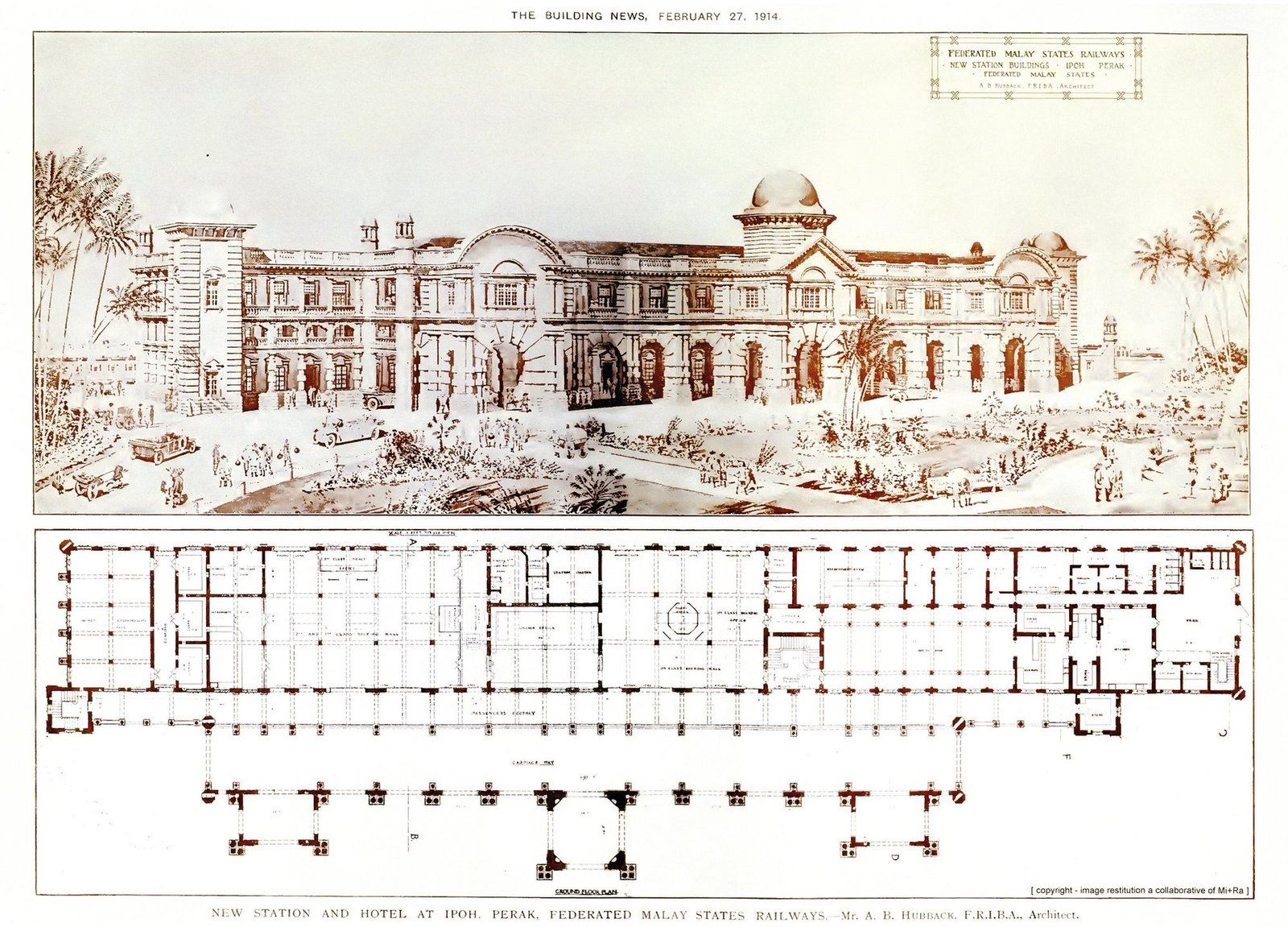
We have told you the story of the station itself in the railway that made Ipoh rich. Today is about the man who drew it.
And in 1914, that man had three big Perak projects on the go. One of them would end up trampled by elephants.
A SULTAN'S VOW, AND TWO ELEPHANTS
In Kuala Kangsar, Sultan Idris of Perak had vowed to build a mosque if he recovered from an illness. He recovered. Hubback designed the Ubudiah Mosque, and on 26 September 1913 the Sultan laid its foundation stone.
Its building was interrupted more than once. In the most famous incident, two royal elephants, one belonging to Raja Chulan and one to the Sultan's family, fought on the site and, by the most often told account, trampled and destroyed the expensive Italian marble. It had to be ordered all over again.
Sultan Idris died in 1916, before his mosque was finished. It was completed in 1917 and opened by his successor, Sultan Abdul Jalil.
But elephants were not the biggest problem. Something much bigger was coming from Europe.
AUGUST 1914
He had sailed for England on long leave on 12 May 1914, with his family. By the time he arrived home in August, he found his country at war.
Hubback, the man who had trained Malaya's volunteers and led them to London, joined up within weeks. In September 1914, he became a major in a London regiment of the British Army.
Back in Malaya, his buildings carried on without him. The war brought shortages of labour and materials. The Italian marble for the Ubudiah Mosque, by local accounts, had to be shipped the long way round, past South Africa. The Ipoh Town Hall was delayed until 1916. The station and hotel were not finished until 1917.
Another architect, Thomas Steele, was sent to Ipoh in 1915, and the Town Hall and Post Office, the station and hotel and the Ubudiah Mosque were all completed under his supervision.
Meanwhile, the man who had drawn them was in France.
WOUNDED ON THE SOMME
In 1915 he commanded a battalion at the Battle of Loos. On 10 March 1916 he was promoted to brigadier-general, in command of 2nd Brigade, which he led until July 1917, through the Battle of the Somme.
On the Somme, he was reportedly badly wounded. His grandson later said the injuries nearly killed him.
He recovered and went back. He commanded brigades until the last battles of the war, was mentioned in dispatches six times, and was made a Companion of the Order of St Michael and St George (CMG) in 1916, and was awarded the Distinguished Service Order (DSO) for his war service.
The architect who had once been told his tower would fall had walked through the worst of the war and stayed standing.
So why didn't he simply come home to Malaya when it ended?
SO, WHY DID HE NEVER COME BACK TO WORK IN MALAYA?
Back to our question.
According to his grandson, Dr Peter Barbor, Hubback had planned to return to Malaya after the war and carry on as an architect. "But the army had other ideas," his grandson recalled: it promoted him and persuaded him to stay.
He never returned to his Malayan post, and never designed another building in Malaya. He stayed in the army until he retired in 1924. When the Second World War began, he tried to sign up again and was turned down because of his age, so he ran a charity for the families of soldiers, sailors and airmen in Hertfordshire instead.
His grandson remembered "a tall, pipe smoking man", reserved after "four years in the trenches", who loved bowling cricket balls at the grandchildren.
Arthur Benison Hubback died on 8 May 1948, at 77, in Broxbourne, Hertfordshire.
So that is the answer. He did not leave Ipoh because he lost interest. He went home on leave, found a war waiting for the volunteer in him, and the army would not give him back.
THE STONE IN FRONT OF HIS STATION
Now look again at that cenotaph in the square.
It was built in memory of "the men from the State of Perak who fell in the Great War 1914-1918", the same war that kept Hubback away from Ipoh. It was unveiled on Armistice Day, 11 November 1927.
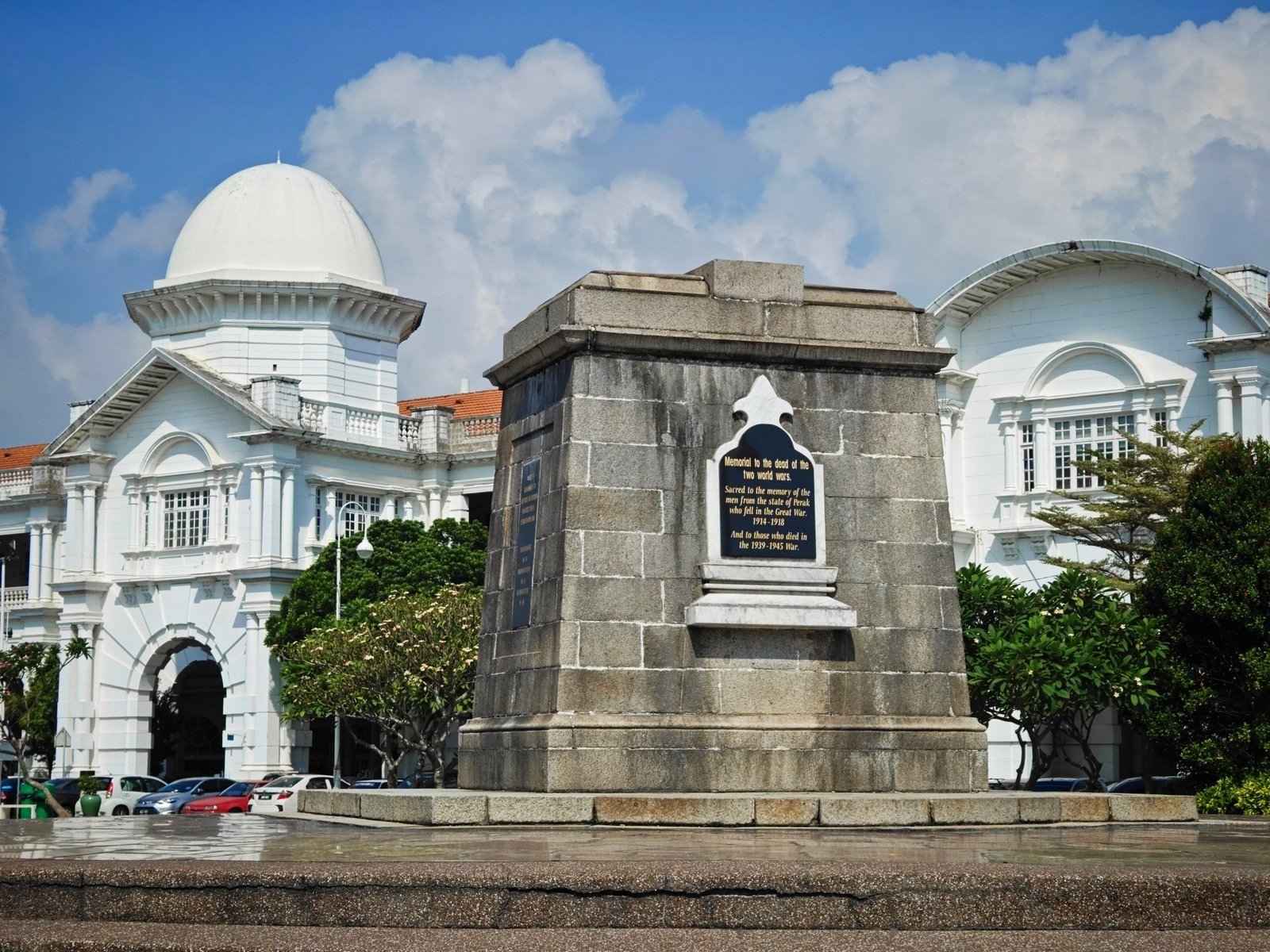
So when people gather at that cenotaph each November for Remembrance Day, they stand in front of a station whose architect was fighting in that same war while it was being built.
And his buildings still need us. Heritage researchers say his name is often misspelled "Hubbock", even on plaques at his own buildings. In January 2025, local reports said there was structural work on the original Anderson School building, with its rear section already demolished.
The station and the Town Hall have outlived him by almost 80 years. Whether the rest of his Ipoh survives is up to us.
THE MILLIONAIRE LESSON
As the founder of Ipoh – The City of Millionaires, here is what I want every student, parent and young entrepreneur to take from A.B. Hubback.
He drew the plans, and others had to finish the job. Ipoh still poses in front of it.
Build work good enough to be finished without you. That is how you outlive your own story.
Have you taken a photo in front of Ipoh Railway Station, or studied at Anderson School? Tell us
He drew Ipoh's grandest buildings, and Ipoh finished them for him. Ipoh shaped their story. Whose story will Ipoh shape next?
This story carries our Ipoh Connections label, for people who were not born in Ipoh but whose life or work has a real tie to the city. It is part of Ipoh Stories, our City of Millionaires heritage series. At Rochford's International School in Ipoh, we believe history, character and critical thinking are best learned through real stories, including the stories of our own city.
Stories in this series are shared for informational and educational purposes. Where accounts differ, we say so. We respect all races, religions and cultures, and we do not represent or endorse any political party or movement.