TAN SRI DARSHAN SINGH GILL AND VELODROM RAKYAT, IPOH: THE LAWYER WHO WENT DOOR TO DOOR TO BUILD MALAYSIA'S FIRST VELODROME, AND THE SON WHO NOW LEADS ASIAN CYCLING
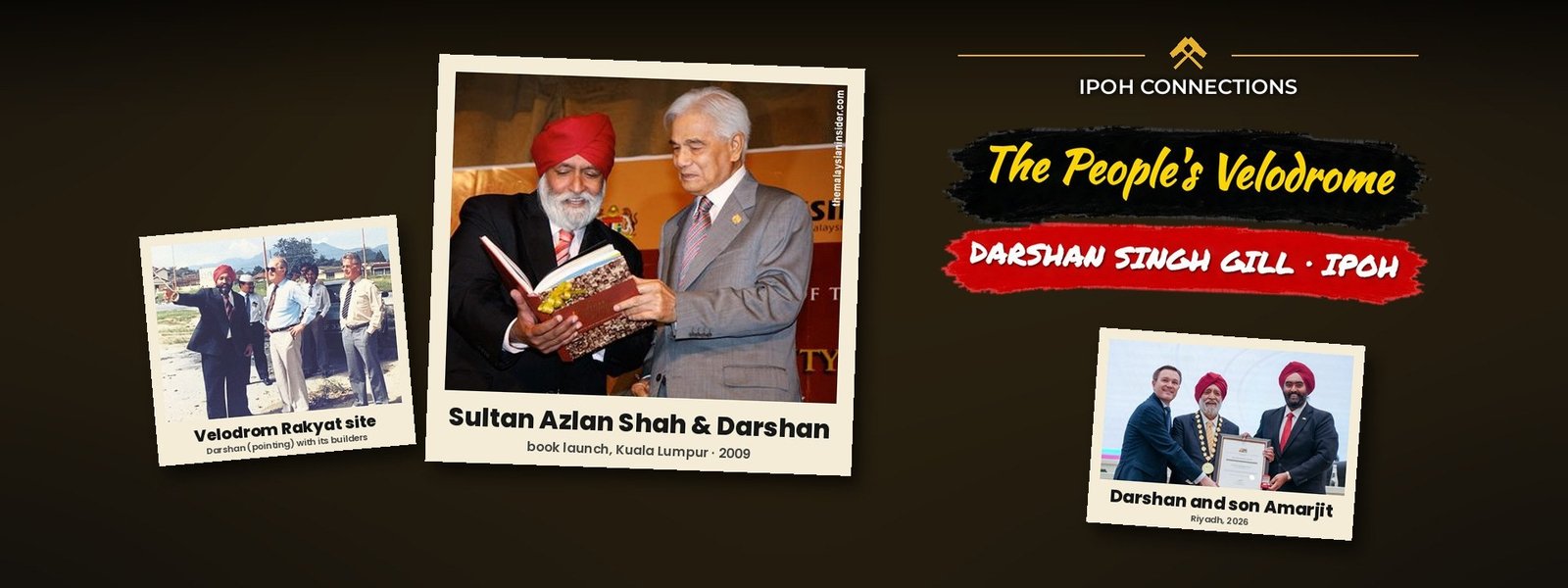
Cover: Sultan Azlan Shah with Tan Sri Darshan Singh Gill at the launch of The Sikh Community in Malaysia, Kuala Lumpur, 28 June 2009 (photo: Gerak Sikh, June 2009); Darshan at the Velodrom Rakyat site (photo: Malay Mail, published 18 April 2015); Darshan with David Lappartient and his son Datuk Amarjit Singh Gill, Riyadh, 12 February 2026 (photo: Twentytwo13, 13 February 2026). All rights remain with the publishers.
He never raced. He just loved watching the races near his home in Ipoh. Then he raised RM3.25 million from the rakyat, the people, and gave Malaysia its first velodrome.
Who is Tan Sri Darshan Singh Gill? Tan Sri Dato' Seri Darshan Singh Gill is an Ipoh lawyer and cycling leader who, with the blessing of his longtime friend Sultan Azlan Shah of Perak, led the public fund-raising drive that built Velodrom Rakyat in Ipoh, Perak, Malaysia, widely described as the country's first velodrome, completed in 1989. He went on to lead the Asian Cycling Confederation, and his son, Datuk Amarjit Singh Gill, now leads Malaysian and Asian cycling and is a vice-president of the UCI, the world governing body.
In the early 1970s, a young man in Ipoh used to go and watch the bicycle races held close to his home on Silibin Road.
He was not a racer. By his own account, he only ever rode an ordinary bicycle.
But he was hooked. He volunteered to help organise the races. Then he joined the Perak Cycling Association.
Less than two decades later, Ipoh had a velodrome, a banked wooden track built just for bicycle racing, the first of its kind in Malaysia. It was paid for, ringgit by ringgit, by ordinary people.
That young volunteer was Darshan Singh Gill.

In this series, we usually tell you about tin barons, Kapitans and heritage buildings. Today's story is about something the people of Malaysia built together, and the man who knocked on their doors to ask.
An Ipoh Connection
Darshan Singh Gill's family has been in Perak for more than a century.
According to an account of the family published in 2009, his great-grandfather, Boor Singh Gill, came from a village in Punjab and started a small cattle farm in Menglembu, near Ipoh. His grandfather arrived in 1911. Both his grandfather and his father later became granthi, priests at a Sikh temple. One profile names his parents as Bhai Gurdial Singh Gill, a priest at the Wadda Gurdwara Sahib in Ipoh, and Daljit Kaur.
The records we found say Darshan himself was born in 1948 in India. He grew up in Ipoh, went to the Anglo-Chinese School (ACS) in Ipoh, and has made the city his home ever since. That is why this story carries our "Ipoh Connections" label.
His father, a temple priest, could only afford to send one of his sons for further studies. "I have to thank my elder brother Gurbax for paving the way for me to read law," Darshan recalled. His brother decided it should be him.
By one account, after leaving school he worked for a short time as a freelance journalist, sending reports and photographs to newspapers and being paid for each piece that ran.
From 1971 to 1975 he was in London. He graduated in law from King's College London and was called to the Bar at Lincoln's Inn. He came home, served as a magistrate (by one account, he chose to serve in Ipoh, the city where he grew up) and built his career as a lawyer in Ipoh. (Earlier in this series, we took you inside the Ipoh High Court and the tunnel beneath it.)
The Vision: A Track of Our Own
When he returned in 1976, he was asked to become president of the Perak Cycling Association. He would lead it for decades.
He saw a problem. Malaysia had no velodrome. To train on a proper track, the national cyclists had to be sent to neighbouring countries, at a very high cost.
So he set out to give Malaysia a track of its own, in Ipoh.
A Sultan's Blessing, and RM20,000 to Start
In 1986, he went to see the Sultan of Perak, Sultan Azlan Shah, to ask for his blessing.
By Darshan's own account, the Sultan did more than give it. "His Majesty not only supported the project, but started the collection with a personal donation of RM20,000," he recalled in 2009 (in Malay; our translation).
Sultan Azlan Shah was himself a sportsman. He played hockey for Perak as a young man, and later became known as the "Father of Malaysian Hockey".
Door to Door
Then the hard part began.
"I went begging door-to-door for funds to build the velodrome," Darshan said. One local account says he went himself to the homes of residents around Ipoh. Newspapers ran a nationwide donation drive. There were fund-raising events. Companies, government agencies and ordinary families gave what they could.
"It seemed a tall order to see the project through when it was mooted in the 1980s but the foundation was finally laid in December 1986," he remembered. "We organised numerous fundraising events and the support from the rakyat was tremendous. That is why we decided to call it the Rakyat Velodrome."
Velodrom Rakyat means "the People's Velodrome".
The total cost was RM3.25 million. Darshan did not design the track himself: he brought in a German velodrome architect, and an Australian track builder, Ron Webb, to build a 250-metre timber track on Jalan Ghazali Jawi in Ipoh.
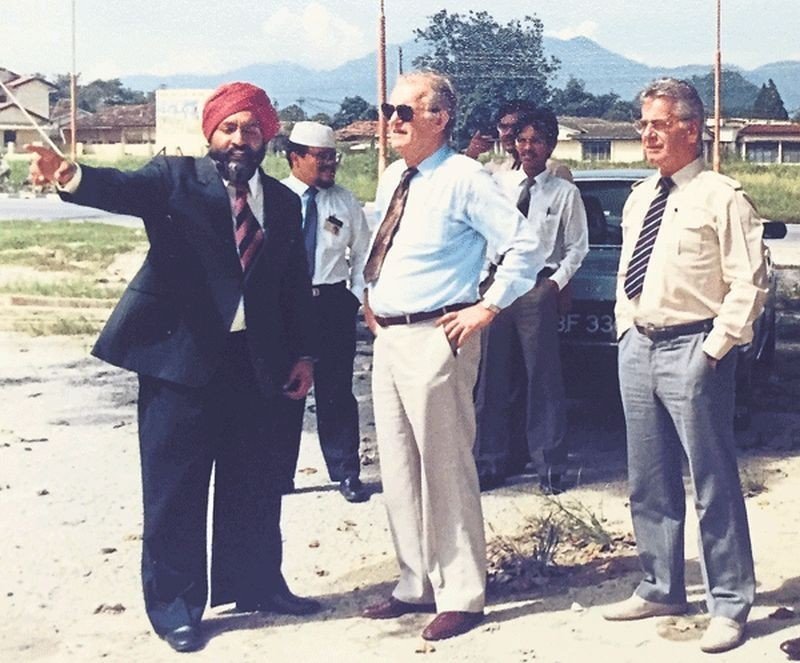
The German architect, named in local reports as Herbert Schumann, appears to be Herbert Schürmann, whose firm built velodromes around the world, including the Olympic tracks for Munich 1972 and Seoul 1988. The firm's own list of the tracks it built includes Velodrome Rakyat, Ipoh (1989), a 250-metre outdoor timber track.
1989: Malaysia's First Velodrome Opens
Velodrom Rakyat was completed in 1989. It was officially opened by Sultan Azlan Shah, who by then was also Malaysia's Yang di-Pertuan Agong, the King.
That same year, Malaysia hosted the SEA Games. The track cycling events were held in Ipoh, and, by Darshan's account, Malaysia's cyclists won four gold medals.
In the years that followed, the People's Velodrome hosted national, regional and world events, including the 1993 Asian Cycling Championships, the 1997 UCI World Championships B and rounds of the UCI Track World Cup in 2000 and 2001.

"The toughest challenge was building the velodrome," he said in 2015. "Seeing it become a reality was the biggest satisfaction, especially with the rakyat's involvement. The journey of having come this far from just being a volunteer at races is something I will always cherish."
From Perak to Asia, and the World
The velodrome was only the beginning.
Darshan joined the council of the Malaysian National Cycling Federation (MNCF) in 1978. In 1989 he was elected its president, in a surprise win over the incumbent, Tan Sri Elyas Omar. He served about a year, and was later named the federation's life president.
In 1990 he joined the board of Asia's cycling body, then called the Asian Cycling Federation, and in 1993 he became its secretary-general. That same year, on 31 March 1993, at a meeting in Ipoh, the federation became the Asian Cycling Confederation (ACC). The ACC, which still has its headquarters in Ipoh, credits him as its founder, and says he led it as president from 1996 to 2005. (One earlier profile gives different years for his presidency.)
He also became the first Malaysian to sit on the management committee of the UCI, the world governing body of cycling. Profiles of him say he has also received the UCI Merit, a distinction the UCI gives to people who have made a remarkable contribution to cycling.
He played a key role in the first Le Tour de Langkawi in 1996, and helped bring the Sultan Azlan Shah Track Asia Cup to Malaysia in 2006, 2007 and 2009.
"I progressed step by step with cycling, from the state level to Malaysia, then Asia and eventually the UCI Management Committee," he said in 2026.
He served other sports too. In the 1980s he was vice-president of the then Malaysian Amateur Athletics Union for a term, and in 2010 he was inducted into the Olympic Council of Malaysia's Hall of Fame. Later, he took up roles in extreme sports in Asia. "I wanted to take a rest, but sports is in my blood," he said in 2015.
Off the bike, he served his community too. He was president of the Malaysian Sikh Union from 1990 to 1994, and later led the Malaysian National Sikhs Movement (GERAKSIKH). On 28 June 2009, in Kuala Lumpur, Sultan Azlan Shah launched Darshan's 266-page book, "The Sikh Community in Malaysia", and wrote its foreword. "It is an instrument of dialogue between cultures," the Sultan said at the launch.

"The Best": Darshan and Sultan Azlan Shah
Their bond went beyond the velodrome.

Darshan was a longtime friend of the late Sultan Azlan Shah, who reigned as Sultan of Perak from 1984 until his death in 2014. He had known the Sultan since 1975.
When the Sultan died in May 2014, Darshan remembered him as a down-to-earth man whose word was as good as his bond. The Sultan, he recalled, had been his rock during the difficult days that led to the building of Velodrom Rakyat, and through many cycling events after it.
Five years earlier, in 2009, Darshan had said he was fortunate to have served under the Sultan, the most charismatic personality he had ever met.
He reportedly became the first Sikh, and the first non-Malay, appointed by Sultan Azlan Shah to the Royal Council of Perak.
"His Majesty is the one ruler every subject dreams of. You could not hope for better. His Majesty is the best," Darshan said in 2009 (in Malay; our translation).
He also admired the Sultan's legal mind. Before he was Sultan, Raja Azlan Shah had been Lord President, Malaysia's top judge. "With his wide knowledge of the law, all the decisions he made were very rational, practical and fair," Darshan, himself a former magistrate, said in the same 2009 interview (in Malay; our translation).
The People's Velodrome Today
Here is the honest part of the story.
Velodrom Rakyat is still standing. It has not been demolished or replaced. But it is an open-air track with no roof, and years of rain and sun have been hard on the timber.
After early 2013, the track was judged too dangerous to use. Millions of ringgit in government funds went into repairs ahead of the 2018 Malaysia Games (SUKMA), and in August 2018 the UCI certified the refurbished track for international competition.
Since then, the wood has deteriorated again. In January 2026, the national federation said the velodrome was unsafe and had been out of operation for over a year.
In April 2026, a proposal for a roof and a new track, at an estimated RM10 million, was presented to the Sultan of Perak, Sultan Nazrin Shah. An aluminium track that would not need a roof has also been suggested. At the time of writing, the plans still await government approval.
The Son Who Carries the Torch
The man pushing hardest to save the velodrome is Darshan's son.
Datuk Amarjit Singh Gill, a lawyer like his father (all four of Darshan's children, three sons and a daughter, became lawyers), took over from him as president of the Perak Cycling Association in 2013, after his father had led it for some 38 years, by one account.
Then he followed his father's path, almost step by step.
In October 2024, he was elected president of the Malaysian National Cycling Federation, and in 2026 he was returned unopposed for a full term. In February 2025, in Bangkok, he was elected president of the Asian Cycling Confederation, the post his father once held. And on 25 September 2025, at the UCI Congress in Kigali, Rwanda, he was elected a vice-president of the UCI, the first Malaysian to hold that post.
In February 2026, at the ACC Congress in Riyadh, Saudi Arabia, Amarjit presented his father with the ACC Presidential Award, the confederation's highest honour, newly created that year, for 50 years of service to cycling. His father was named its first recipient. "I have never stopped serving the sport of cycling," Darshan said. In August 2026, at 78, he also received a Thai royal decoration for his service to the sport. "It is not only a recognition for me, but also for Malaysia and the entire cycling fraternity," he said.

For Amarjit, the velodrome his father built is personal. "This is about giving our northern athletes a proper home base," he said in 2026. "It is not just an upgrade; it is an investment in the future of Malaysian cycling."
What Tan Sri Darshan Singh Gill Teaches Our Students
First lesson: you do not have to be the star to change the game.
He never raced. He volunteered. That was enough to start a 50-year journey.
Second lesson: a big dream needs many small hands.
RM3.25 million was raised door to door. The People's Velodrome belongs to everyone who gave.
Third lesson: ask for help, and ask the right people.
A Sultan's blessing and his RM20,000 got the drive started. Ordinary Malaysians finished the job.
Fourth lesson: building is only half the work.
A track left to the rain falls apart. What we build, we must also look after.
Fifth lesson: pass it on.
The son now holds the posts the father once held, and is fighting to save what his father built.
Ipoh Connections
He was not born in Ipoh, by the records we found. But he grew up here, studied here, practised law here, and gave Ipoh a place in the history of Malaysian sport.
Next time you drive past the old velodrome on Jalan Ghazali Jawi, remember: it was built by the people, one donation at a time, because one man knocked on their doors.
Did you ever watch a race, or ride, at Velodrom Rakyat in Ipoh? Tell us
This story carries our Ipoh Connections label, for people with deep roots in Ipoh who, as far as the records show, were not born here. It is part of Ipoh Stories, our City of Millionaires heritage series. At Rochford's International School in Ipoh, we believe history, character and critical thinking are best learned through real stories, including the stories of our own city.
Stories in this series are shared for informational and educational purposes. Where accounts differ, we say so. We respect all races, religions and cultures, and we do not represent or endorse any political party or movement.