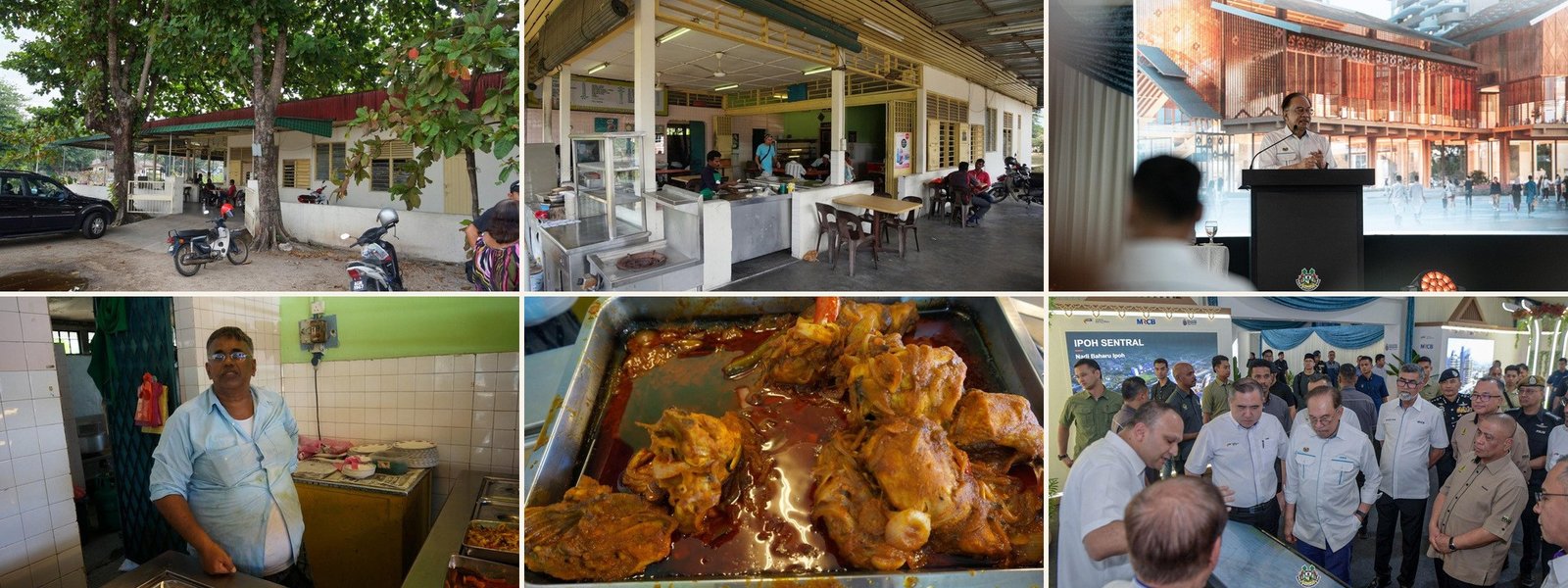
The Goodshed Murtabak of Jalan St John
You might remember the Goodshed on Jalan St John by its murtabak. But picture the world around the table, too: the railway goods yard just across the road, and a corner of Ipoh built around moving goods.
Picture the contrast: the hiss of a griddle close at hand, the heavier rumble of trains beyond it; a crisp edge of roti canai breaking beneath the fingers while the sound of cargo lorries carries across the road. Here, a meal belonged to a neighbourhood shaped by the movement of goods.
A restaurant named after its neighbour
At the junction of St John's Road and Jalan Sanders, the restaurant was first known simply as the murtabak restoran. It later took its Goodshed name from the railway goods shed opposite.
The railway quarters around Jalan Sanders formed part of this setting. The restaurant's name kept that connection to the working railway landscape, even as the neighbourhood changed.
By the time a local writer described the area in 2014, the former goods shed site was the Ipoh inland port terminal.
A meal beside a working town
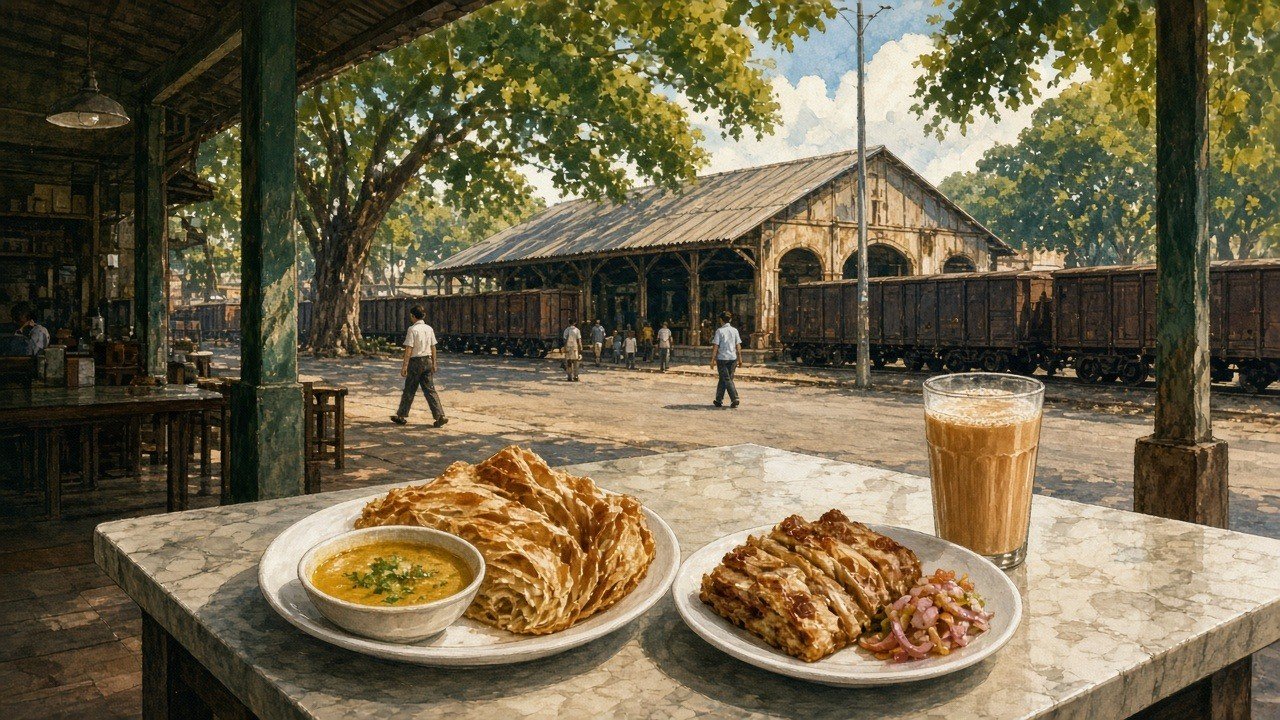
Illustration of a mamak table across the road from Ipoh's railway goods shed: an artistic impression, not an exact view of the Goodshed.
The appeal of roti canai and murtabak begins with simple things: thin dough, a hot griddle and the pleasure of eating while the edges are still crisp. Murtabak makes a more substantial parcel, its filling enclosed within the folded dough. These familiar mamak dishes offer their own small comfort against the scale and noise of a working town.
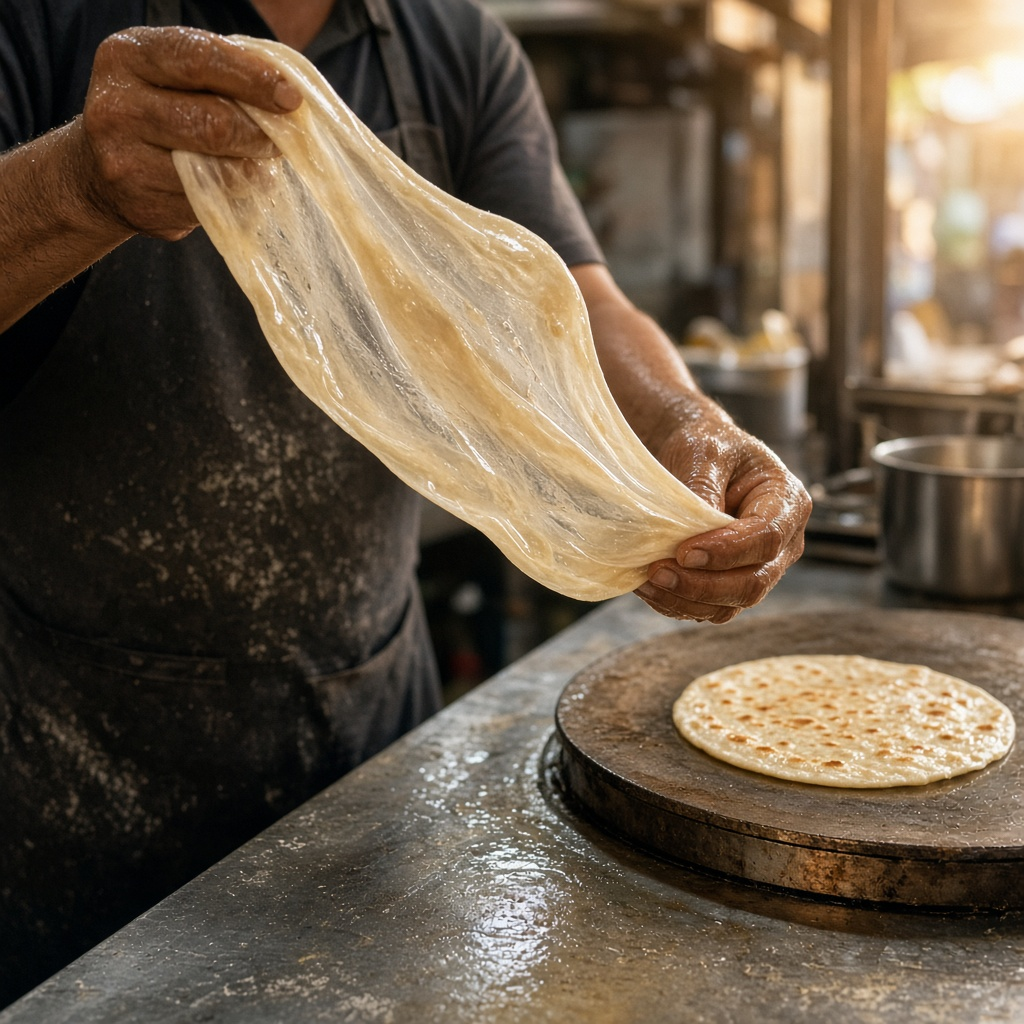
In the mind's eye, the griddle answers the goods yard: a close, quick sizzle against a distant metallic rumble. Across the road lies the world of freight; at the table, attention returns to another mouthful. The railway goods yard, and later the inland port with its cargo lorries, formed the changing backdrop to this familiar place to eat.
Older food writers praised the Goodshed's roti canai and murtabak. Their accounts also mention ayam roast, kambing kurma, nasi biryani and crab curry, and describe a partly wooden, partly tiled restaurant beneath trees. A local writer recalled 1970s prices of 15 cents for roti canai and one dollar for murtabak.
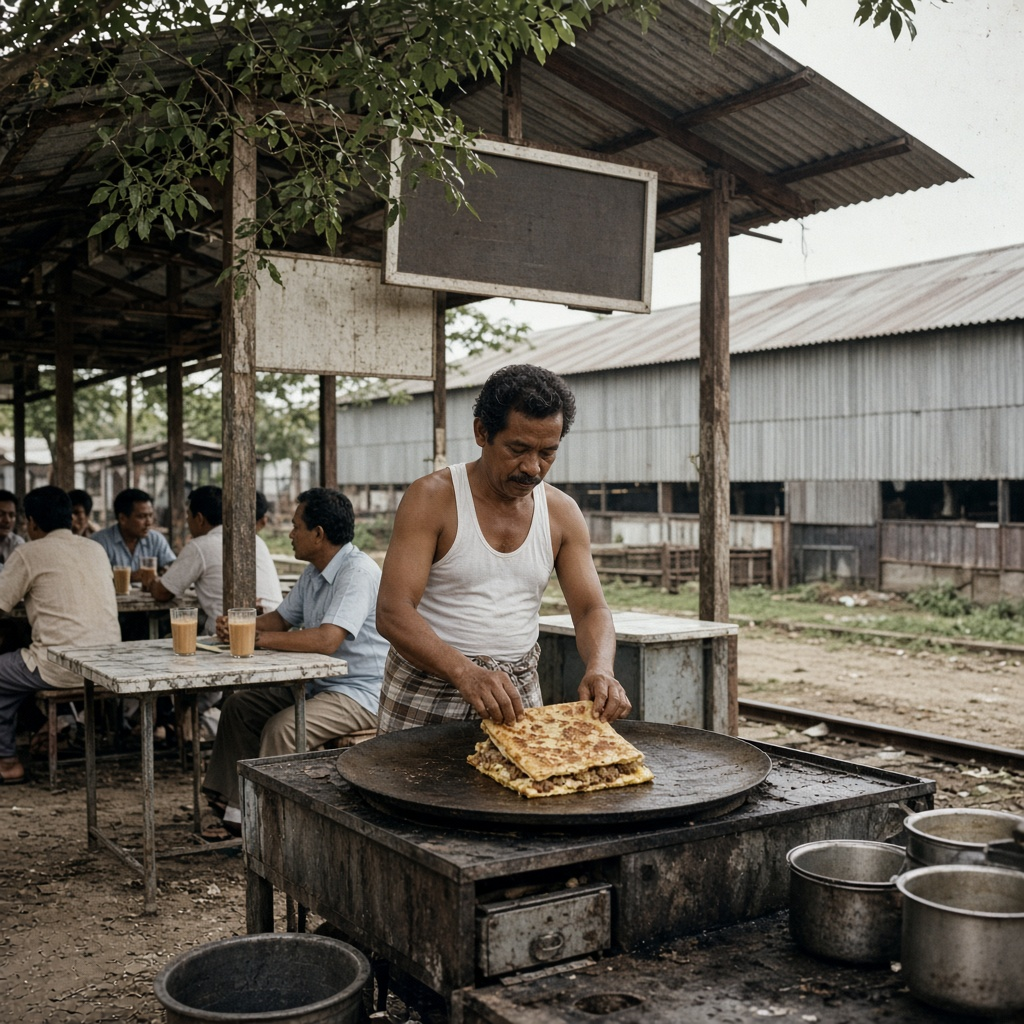
A 2014 food account noted that the Goodshed had outlasted Rahman Restaurant and Federal Muslim Restaurant. It was a survivor then, though its own chapter would also come to an end.
One reader remembers
One reader recalls visiting during his primary school days with his father and uncles. He remembers the once-famous murtabak and roti canai, and how worn down the place looked in later years.
The recollection is modest, but its heart is clear: a child being taken out to eat by the older people in his family. The meal survives in memory together with the company.
Today the Goodshed is shut down, and its site is set to become part of Ipoh Sentral under the state government's redevelopment plans.

Illustration of a later inland-port scene with cargo lorries and rail freight: an artistic impression of a different era, not the childhood scene described above.
What is planned for Ipoh Sentral?
Ipoh Sentral is a redevelopment of railway land beside and behind Ipoh Railway Station, rather than a replacement for the historic station itself. The announced scheme covers about 27 hectares, or 67 acres, with an estimated gross development value of RM6.25 billion—not a figure for money already spent. The transport minister’s groundbreaking speech of 16 August 2025 gives the precise area as 66.651 acres.
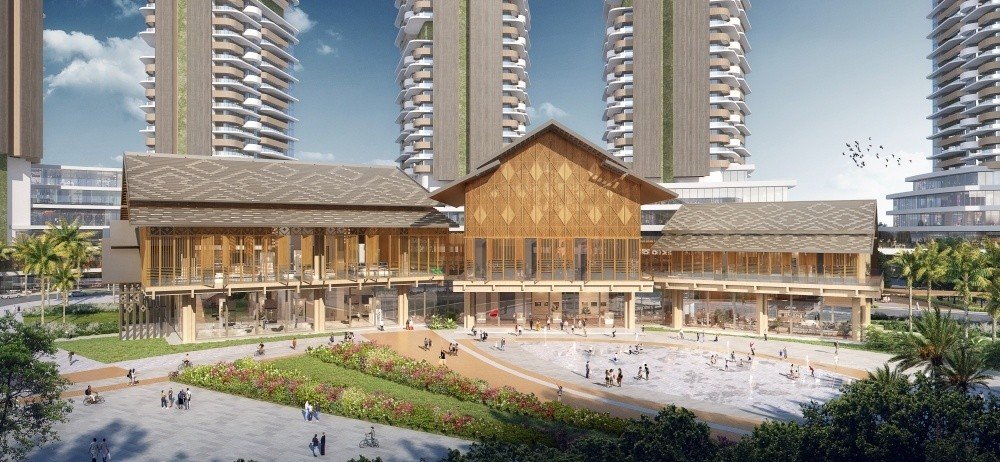
The project brings together Ipoh Sentral Sdn Bhd—a partnership between Railway Assets Holding, under the Railway Assets Corporation (RAC), and Silver Smart, under the Perak State Secretary Incorporated—and Country Annexe, a wholly owned MRCB subsidiary. Their development agreement was announced on 11 July 2025. Ipoh City Council records the groundbreaking on 16 August 2025.
The first phase centres on a 6.31-acre green space, landscaping and recreation, with a mosque also planned. The larger second phase proposes serviced apartments, offices, shops, hotels and community facilities. The transport aim is to bring rail, buses, taxis and e-hailing together with walking and cycling routes: a neighbourhood organised around public transport, rather than simply another collection of buildings.
There is a distinction between work underway and the longer-term vision. In a state-assembly update reported on 8 September 2026, Menteri Besar Saarani Mohamad said landscaped-park construction had begun early in 2026. Mosque construction was scheduled for the end of 2026, the integrated terminal and shopping centre for 2027, and housing for 2028. Those remain announced targets, not completed milestones; subsequent phases are intended to unfold over roughly 20 years, subject to market conditions. The project company also reported a park-work progress visit on 29 September 2026.
For the Goodshed story, this is the next proposed chapter in a railway neighbourhood long associated with freight, lorries and everyday meals. Under the state government's redevelopment plans, the closed eatery's site is set to become part of Ipoh Sentral.
Help keep the memory alive
A reader shared this memory while helping a friend document Ipoh's old eateries. Other recollections and old photographs could help fill the gaps: who cooked there, what people ordered, and how the restaurant and its surroundings changed. Even a small detail can help bring this corner of old Ipoh back into view.
Here is what we can learn from this
Perhaps an old eatery preserves more than a favourite dish. It can hold something of the streets around it—their sounds, their work and the people who brought us there. Recording those small details carefully may help keep a changing neighbourhood within reach, without pretending that every memory tells the whole story.
This is the City of Millionaires. We are more than just buildings. We are the people who built it.
This story is part of People in Perak. Lives with a story to tell., our City of Millionaires heritage series. At Rochford's International School in Ipoh, we believe history, character and critical thinking are best learned through real stories, including the stories of our own city.
Sources: Harry Seggu: Remembering My Old Stomping Ground, Jalan Sanders, Ipoh; Food and Places: Goodshed Restaurant Ipoh. Illustrations are artistic impressions, not historical photographs of the restaurant.
Stories are shared for informational and educational purposes; where accounts differ or rest on oral history, we say so. We respect all races, religions and cultures.